
National Cake: The NPP-NDC Political Confectionery

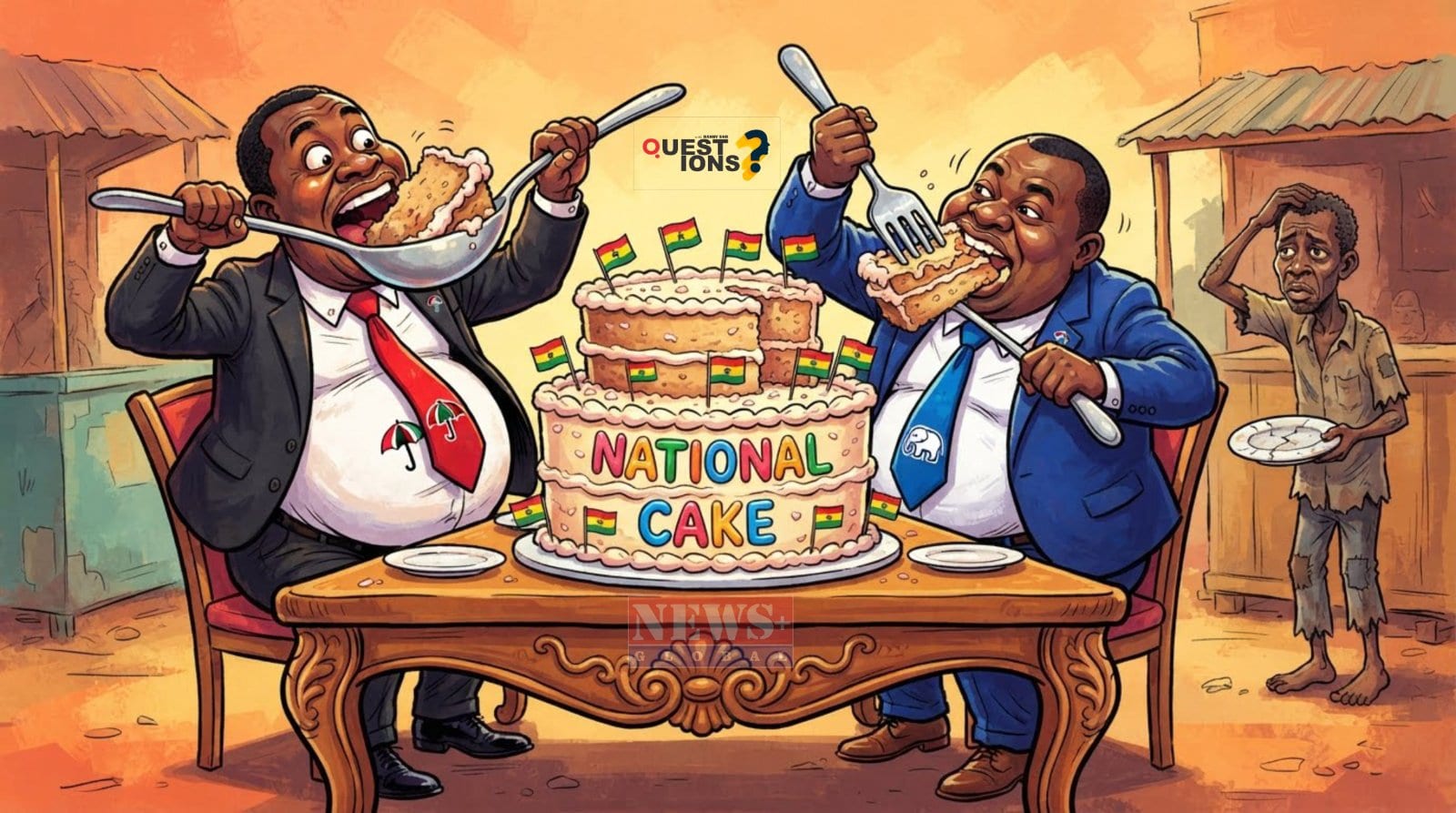
Ghanaian politicians, across both the New Patriotic Party (NPP) and the National Democratic Congress (NDC), have consistently operated on an elite consensus to divide the "national cake" among themselves rather than addressing the structural plight of ordinary citizens. Over the last 30 years of the Fourth Republic, governance in Ghana has mirrored a cyclical tag-team match where the colors change from umbrella red to elephant blue, but the appetite for public resources remains identically ravenous.
The Ghanaian "national cake" is a culinary miracle. It is the only pastry in the world that expands to feed hundreds of politicians, ministers, and presidential staffers, yet somehow leaves thirty-three million citizens staring at empty plates. For over three decades, the National Democratic Congress (NDC) and the New Patriotic Party (NPP) have taken turns in the kitchen. They wear different aprons, but they use the exact same recipe: bake with public debt, frost with tax increases, and slice exclusively for friends, family, and party stalwarts.
To understand this tragic comedy, one must look back to the dawn of the Fourth Republic in 1993. When the late Jerry John Rawlings swapped his military fatigues for a civilian smock, Ghanaians breathed a sigh of relief, believing democracy would bring economic salvation. Instead, it birthed a highly sophisticated duopoly. The NDC and NPP quickly realized that fighting each other on the radio was excellent theater, but cooperating behind closed doors to share state assets was excellent business. It is a beautiful dance: one party holds the knife, the other waits with a plate, and the ordinary Ghanaian provides the flour through taxes.
Consider the sheer scale of the executive apparatus. Every four to eight years, a new president promises a lean government. Yet, upon taking office, the appointments multiply like amoeba in contaminated water. In recent political history, Ghana witnessed an executive branch ballooning to over 110 ministers and state deputies. When citizens complained about the fiscal strain, the justification was that "the harvest is plenty, but the laborers are few." In reality, the cake was simply too big for a small crew to finish, requiring an army of party loyalists to help chew through the budget.
The comedy deepens when you observe the phenomenon of ex-gratia—the constitutional parting gift given to political office holders every four years. Under Article 71 of the 1992 Constitution, politicians have successfully insulated themselves from the very economic hardships they create. While a retired teacher or nurse waits months for a meager pension that inflation has already reduced to pocket change, a Member of Parliament or Minister receives a lump sum worth hundreds of thousands of cedis, only to return to the same office after an election and start qualifying for the next round of cake. It is the only job on earth where you get a massive severance package for a contract you just renewed.
This elite consensus is best demonstrated by the structural decay of public healthcare. While ordinary Ghanaians face the dreaded "no-bed syndrome" at Korle Bu Teaching Hospital or are forced to sleep on floors in regional clinics, the political elite have built a parallel healthcare system called the medical evacuation flight. The moment a politician sneezes or suffers a mild bout of fatigue, they are flown to London, Paris, or South Africa on the taxpayer's dime. The message is clear: the national cake can buy foreign doctors for the rulers, but the ruled must rely on prayer and luck.
Education has suffered a similar fate under this competitive mismanagement. The transition between governments often resembles a demolition derby. When one party introduces a educational policy, the incoming party either underfunds it to prove a point or rebrands it to take the credit. The result is a broken basic school system where children in rural communities still study under trees, without textbooks or desks, while politicians host lavish gala dinners in Accra to celebrate "educational milestones." They feast on the cake while the future of the nation scrambles for crumbs in the dust.
The infrastructure sector provides the ultimate comic relief, if one can laugh through tears. Road construction in Ghana is treated not as a public necessity, but as an election-year magic trick. For three years, roads are left to develop craters deep enough to double as fish ponds. Then, six months before a general election, asphalt-laying machines magically appear, working furiously under the cover of night. These "political roads" are carefully engineered to last exactly until the last ballot box is counted, washing away with the first rain of the new administration.
Then comes the tragic saga of the country's natural resources. Ghana is blessed with gold, oil, bauxite, and cocoa, yet the state treasury is chronically empty, perpetually on life support from the International Monetary Fund (IMF). Over the last 30 years, Ghana has returned to the IMF multiple times, each trip treated by the sitting government as a badge of honor and by the opposition as proof of treason. When the NPP is in power, an IMF bailout is a "strategic stabilization pill"; when the NDC is in power, it is "gross economic incompetence." The actors change scripts seamlessly, depending on who is sitting at the head of the table.
The institutionalization of corruption has been perfected through specialized state vehicles. Take the perennial issue of judgment debts—payments made by the state to private entities for breached contracts. Over the decades, hundreds of millions of dollars have been paid out because one administration arbitrarily cancelled a contract signed by its predecessor, often just to hand the same contract to a friendly businessman. It is a genius loophole: the politician punishes the political rival, the state pays the bill, the crony gets rich, and the national cake vanishes into private offshore accounts.
Even the fight against corruption has become a comedic routine. Both parties have mastered the art of setting up committees, commissions of inquiry, and anti-corruption agencies that are intentionally starved of funds or teeth. When an official is caught in a scandal, the standard procedure is not prosecution, but a "reassignment" to the Office of the President or a diplomatic post abroad. Corruption is never punished; it is simply reshuffled. The public is treated to endless media probes that dominate headlines for weeks, only to be buried by the next scandal in a perpetual cycle of state-sponsored amnesia.
The environmental degradation caused by illegal mining, popularly known as galamsey, highlights the ultimate betrayal of the citizenry. Water bodies like the Pra, Ankobra, and Brim have turned into thick, toxic chocolate beverages due to unregulated mining. Both the NDC and NPP have launched military task forces, spent millions of cedis on "containment," and made fiery speeches vowing to put their presidencies on the line. Yet, the muddy waters keep flowing because the excavators belong to party executives, regional chairmen, and powerful financiers from both sides of the aisle. The cake is being mined directly out of the earth, even if it poisons the water the citizens drink.
Agriculture, the supposed backbone of the economy, has been reduced to seasonal rhetoric. Programs are launched with grand, poetic names designed to look good on billboards and donor funding applications. Meanwhile, the actual peasant farmer in the Upper East or Volta region cannot access fertilizer, lacks storage facilities, and watches their tomatoes rot by the roadside due to bad transportation networks. Ghana continues to import hundreds of millions of dollars worth of rice, onions, and frozen chicken annually, proving that the politicians prefer buying foreign food with state loans rather than empowering local production.
The energy sector has its own unique dark humor. For decades, Ghanaians have endured dumsor—erratic power supply that ruins businesses and destroys household appliances. The response from the political class has not been a sustainable technical solution, but a war of vocabulary. One party claims they "brought the power," while the other claims they "managed the financial crisis that caused the outages." While they argue over semantics, cold store operators watch their fish rot, and barbers sit idly under the scorching sun, waiting for the grid to remember them.
Public housing projects across the country stand as concrete monuments to this generational negligence. Massive housing estates, started by one administration, are routinely abandoned by the next simply because completing them would give political credit to the rival party. Millions of dollars in taxpayer money rot away in the bushes of Saglemi and other sites, while millions of Ghanaians are priced out of the rental market or forced to live in slums. The politicians would rather let a building collapse than allow the opposition's name to remain on the plaque.
The financial sector cleanup of recent years showed just how deep the rot goes. While the state spent billions of cedis to bail out failing banks and protect depositors, the underlying collapse was driven by massive, unsecured loans handed out to politically exposed persons. When the dust settled, indigenous banks were collapsed, thousands lost their jobs, and ordinary citizens had their life savings locked up or heavily discounted. The elite, however, emerged unscathed, their private wealth intact, ready to fund the next election campaign.
Election campaigns in Ghana have become the ultimate market square where the national cake is briefly shared in microscopic fractions. Every four years, politicians descend from their V8 SUVs into the muddy gutters of the electorates. They are suddenly seen frying yams with market women, pounding fufu in mud huts, and sharing 50-cedi notes wrapped in party T-shirts. For three months, the politician pretends to be a servant, and the citizen pretends to be a king. The moment the results are declared, the tinted windows of the V8s slide back up, and the long drive back to the elite suburbs of Accra begins.
The judiciary and regulatory institutions have not been spared from this creeping politicization. Appointments to key state positions—from the Electoral Commission to the Supreme Court—are heavily contested along partisan lines. The goal is never to build strong, independent institutions, but to pack them with friendly faces who will protect the party’s interests when the inevitably chaotic election disputes arise. The umpire is bought before the match even begins, leaving the spectator completely defenseless.
The tragic reality is that this system has created a psychological dependency among the populace. Because public services are broken, citizens are forced to beg individual politicians for school fees, hospital bills, and funeral donations. The politician uses the very wealth stolen from the public purse to act as a benevolent savior, dispensing tiny favors to the desperate. It is a masterclass in political gaslighting: breaking a man's legs, and then expecting him to be grateful when you buy him a pair of crutches.
The national debt stock is perhaps the most frightening evidence of this multi-generational heist. Over the past 30 years, Ghana’s debt has grown exponentially, moving from millions to hundreds of billions of cedis. Much of this money was borrowed under the pretext of development, yet there are few sustainable assets to show for it. The money was consumed by bloated contracts, inflated procurement costs, and the running expenses of a lavish state bureaucracy. The politicians have eaten the cake, licked the pan, and left the bill for the unborn grandchildren of ordinary Ghanaians to pay.
Even the state transport systems tell a story of deliberate neglect. While Metro Mass Transit buses and railway projects rot into scrap metal due to poor maintenance and partisan management, private transport companies owned by political elites flourish. The state is systematically starved so that private enterprises owned by the rulers can thrive on the misery of the public. The citizen is left to squeeze into dilapidated trotros, risking life and limb daily, while the rulers glide past in convoys of armored luxury vehicles.
The foreign policy of the nation has similarly been commercialized. Diplomatic passports are distributed like party flyers, sometimes finding their way into the hands of questionable characters. Embassies abroad are often staffed not by career diplomats who understand international trade, but by stranded party loyalists who need a foreign posting to enjoy their slice of the cake away from the domestic heat. The nation's global image is traded for partisan patronage.
Local government is completely castrated by design. The District Assemblies Common Fund, meant to bring development directly to the grassroots, is chronically delayed or diverted by the central government. District Chief Executives (DCEs) are appointed directly by the President, making them accountable to the Jubilee House rather than the local communities they govern. If a DCE spends time fixing local problems instead of organizing party delegates for the next primary, they are promptly dismissed. The cake must be managed from the top.
The civil service, which should be the anchor of state continuity, has been thoroughly neutralized. Competent, career bureaucrats are routinely bypassed or pushed into "ghost departments" where they have titles but no duties, replaced by political special assistants whose only qualification is their ability to shout slogans on political talk shows. Professionalism has been traded for sycophancy, ensuring that no state institution can resist the looting mechanisms of the sitting government.
Ultimately, the last 30 years of Ghana’s Fourth Republic have proven that the political divide between the NDC and the NPP is an illusion. They are two sides of the same coin, two spoons dipping into the same soup, two politicians eating the same cake. They understand that as long as they can keep the population divided over tribes, religion, and superficial party colors, no one will look at the kitchen to see who is actually stealing the flour. It is a masterpiece of political comedy, but for the millions of Ghanaians watching from the fringes of poverty, the joke has long stopped being funny.
Comments
Join the conversation. Please keep it respectful.
No comments yet — be the first to share your thoughts.