
FROM ANTALYA TO ADDIS ABABA: HOW ETHIOPIA IS BUILDING THE DIGITAL FOUNDATIONS FOR CLIMATE ACTION

By: Tewodros Balcha - ETHIOPIA (International Correspondent)
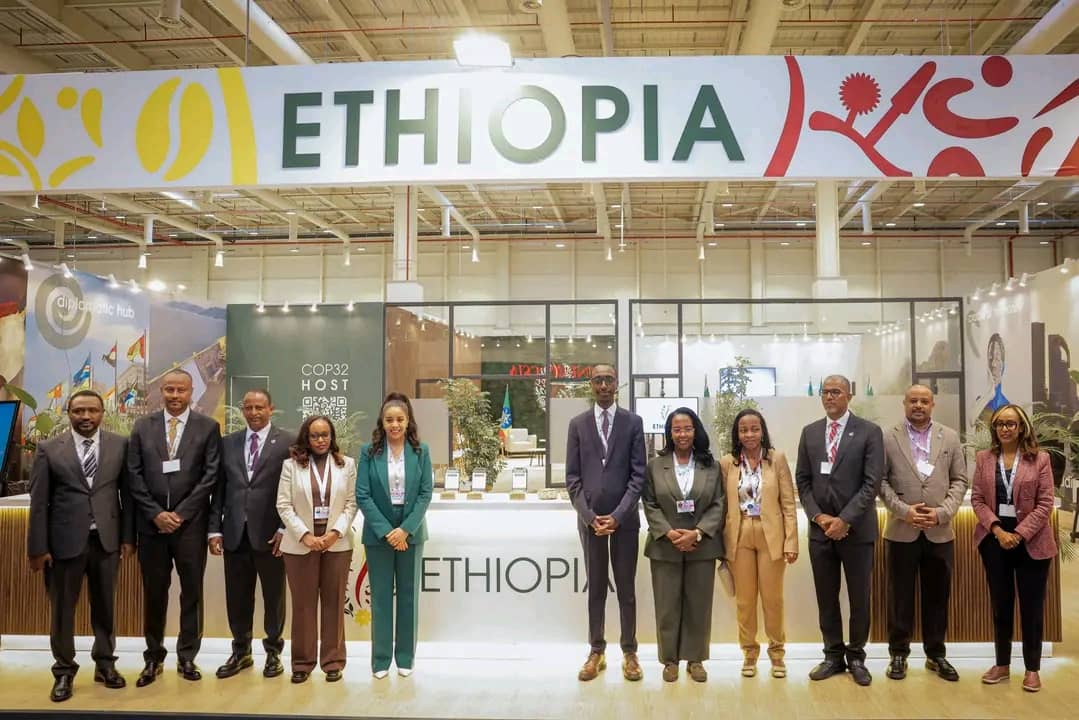
FEATURE: ADDIS ABABA/ANATALYA - The opening of Ethiopia’s pavilion at COP31 marks the start of a year in which the country will take a more prominent place in international climate diplomacy. Foreign Minister Gedion Timothewos, COP32 President-Designate, inaugurated the pavilion alongside Finance Minister Fitsum Assefa, chief negotiator for the Addis Ababa summit scheduled for November 2027.
The pavilion showcases Ethiopia’s climate programmes and creates space for partners ahead of COP32. A second, less-discussed dimension of the country’s development also deserves attention: its growing digital infrastructure and the practical ways that infrastructure can support climate adaptation, agricultural resilience and public service delivery.

Ethiopia’s digital transformation is usually framed around connectivity, financial inclusion and government modernisation. Increasingly it intersects with the climate agenda. Agricultural advice, weather forecasting, environmental monitoring, financial services and national planning all depend on the capacity to collect, process and share reliable information. Mobile money operates at national scale, national digital identity is expanding, and platforms for agriculture and environmental intelligence are taking shape. AI-supported forecasting and satellite monitoring are still building operational reach. These capabilities do not yet form a single digital climate system. They form a growing set of tools that, if better connected, can make climate information more accessible, financial services more inclusive and adaptation programmes more responsive.
A climate agenda shaped by technology
Technology now sits at the centre of international climate discussions. Artificial intelligence, satellite observation, advanced data systems and digital infrastructure are changing how governments understand environmental conditions, anticipate risks and organise responses.
At COP31 the International Telecommunication Union’s Green Digital Action initiative is advancing work on digital technologies’ contribution to environmental goals, including responsible innovation and the sustainability of the digital sector itself. The COP31 Presidency has also launched the Antalya Artificial Intelligence Pledge with the ITU, focusing on how AI is designed, procured, powered, deployed, measured and managed in support of climate and sustainable development objectives.
The United Nations’ Early Warnings for All initiative aims to protect everyone on Earth with effective early-warning systems for hazardous weather, water and climate events by the end of 2027. Its framework links risk knowledge, observation and forecasting, warning communication, and preparedness and response.
These priorities share one practical challenge: information must reach the people who act on it. A forecast has limited value if it never arrives. Environmental data becomes useful when it informs agricultural decisions, public planning and investment. Financial services strengthen resilience when producers and businesses exposed to climate risks can actually use them. The task is therefore not only to develop new technologies, but to connect scientific information, digital infrastructure, institutions and the people whose decisions determine how climate risks are managed.
From Digital Ethiopia 2025 to the next phase
Ethiopia’s digital ambitions rest on a policy foundation that predates COP32 preparations. Digital Ethiopia 2025 expanded connectivity, encouraged private-sector participation, modernised public services and laid the groundwork for a digitally enabled economy. The government later assessed that the strategy had largely achieved its goals.
Measurable progress supports that view. A World Bank review of digital-sector investments between 2020 and 2024 recorded seven million additional unique mobile subscribers, a rise in mobile penetration from 26 to 33 per cent, and a reduction of more than 90 per cent in mobile data costs since 2018. By the end of 2024 mobile money had reached roughly 60 million users and more than 3,000 digital firms had been licensed since 2022.
Digital Ethiopia 2030, launched in December 2025, shifts the focus from access to capability: public digital infrastructure, data governance, the artificial intelligence ecosystem and national capacity to participate in the digital economy. Targets include training 10 million citizens in digital skills, supporting 5,000 operational startups, creating one million digital-sector jobs and raising the sector’s contribution to 12 per cent of GDP by 2030. Priorities also include national cloud infrastructure, structured data for decision-making, local-language AI and more integrated digital service delivery.
Although Digital Ethiopia 2030 is not a climate strategy, its infrastructure has direct implications for agriculture, environmental management, finance and public administration. Ethiopia is moving from building foundational digital services to connecting and using them more effectively.
Climate intelligence for farmers and pastoral communities
Reliable environmental information is the foundation of digital agriculture. Ethiopia is strengthening both observation networks and the tools that turn data into usable advice.
In September 2026 a contract was signed for 107 automatic weather stations across 107 woredas, expanding the network managed by the Ethiopian Meteorological Institute (EMI) under the second phase of the Lowlands Livelihood Resilience Project, supported by the World Bank. EMI is also working with the University of Chicago’s Human-Centered Weather Forecasts Initiative, backed by the Gates Foundation, to develop AI-powered forecasts tailored to Ethiopian farmers. The collaboration aims to improve the relevance of weather information while building local meteorological expertise. More reliable, locally relevant forecasts can guide planting, planning and harvesting decisions and support water management and extreme-weather preparedness—provided the information reaches farmers through channels they already use.
Pastoral communities need different information. The ET-Monitoring platform supplies near-real-time data on water points, water availability and pasture conditions. Developed with Ethiopian research and public institutions and international partners, it is available in English, Amharic and Afaan Oromo and is designed to help pastoralists, agro-pastoralists and local authorities decide on livestock movement, grazing and water access. A 2026 case study from Borana Zone and the Somali Region showed how a related monitoring and early-warning system combined environmental data and seasonal forecasts with community information centres, SMS alerts and radio to support anticipatory action.
ATI’s National Rangeland Health Monitoring System adds satellite-based environmental intelligence. It combines satellite imagery with ground data to track rangeland conditions and support livestock management, environmental planning and disaster response. After validation and launch for Afar Region and Dire Dawa Administration in May 2026, rollout continued in the Somali Region in September.
These initiatives show how different forms of climate intelligence can serve distinct needs. A farmer deciding when to plant, a pastoralist assessing water and pasture, and a regional planner monitoring rangelands require different information. The practical test is whether that information is timely, relevant and accessible.
Digital finance operating at scale
One of the clearest results of Ethiopia’s digital transformation is the rapid expansion of financial services. Ethio Telecom’s telebirr platform has grown from a payments service into a major part of the digital financial ecosystem. In its 2025/26 results the company reported 60.59 million customers and 4.19 trillion birr in transactions during the fiscal year; cumulative transaction value since launch exceeded 9.13 trillion birr. The platform processed 2.61 billion transactions, supported by more than 410,000 agents and 440,000 merchants, and completed integration with 33 banks. Microfinance and digital credit services reached 21.64 million customers, with 19.51 billion birr in collateral-free digital lending to 5.65 million customers and 18.75 billion birr in digital savings from 1.3 million customers.
Safaricom Ethiopia reported 13.6 million customers active over a 90-day period by the end of its 2025/26 financial year, with M-PESA reaching 5.2 million customers. The company had expanded to 3,504 sites, achieved 59 per cent 4G population coverage and recorded service revenue growth of 130.9 per cent year-on-year to 15.9 billion birr.
This scale matters for climate resilience because farmers and small businesses need financial services to invest, trade and manage uncertainty. Established mobile-payment networks can become channels for agricultural finance, insurance and other climate-related products that reach customers outside conventional banking. These platforms are not climate-finance systems; their value lies in the reach and infrastructure they already provide.
Fayda and the connected digital economy
Fayda, the national digital identity programme, is another core component. As of 9 November 2026 the official dashboard recorded more than 53.8 million registrations, more than 214 million electronic know-your-customer authentication events and 150 integrated partners. In December 2025 the National Bank of Ethiopia and the National ID Programme launched an initiative to harmonise bank accounts with national identification, strengthening verification and access to financial services. President Taye Atske Selassie later cited 257 million mobile-money and mobile-banking accounts and more than 24 trillion birr in transactions in the first nine months of 2026—figures that measure accounts and volume rather than unique individuals, yet still illustrate the scale of activity.
For agriculture and climate programmes the combination of identity verification and digital payments improves beneficiary identification, facilitates payments and links producers with financial institutions and markets. Effectiveness depends on how well institutions integrate these systems into practical delivery.
Digital agriculture: connecting information, services and markets
Agriculture is where several of Ethiopia’s digital capabilities can converge most directly. In February 2026 the Ethiopian Agricultural Transformation Institute (ATI), working with the Center for Open Societal Systems and Protean eGov Technologies, launched Ethiopia OpenAgriNet. Designed as interoperable digital public infrastructure for agriculture, it aims to connect farmers, extension services, markets, climate intelligence, financial services and government programmes through a shared network, with a longer-term goal of reaching millions of farmers by 2032.
The initiative treats advisory services, market access, financial products and climate information as linked rather than separate channels. It is still developing; impact will depend on implementation, institutional participation and the services ultimately delivered. Its value at this stage lies in the architecture it seeks to establish. Fayda, telebirr and OpenAgriNet together address identity, payments and the agricultural information layer. The task for partners is to ensure these systems respond to the realities of smallholder agriculture.
From environmental restoration to geospatial intelligence
Ethiopia’s Green Legacy Initiative, launched in 2019, has become a major national programme for tree planting and landscape restoration. By August 2026 more than 54.5 billion seedlings had been planted. As restoration scales, satellite observation and geospatial tools become more useful for monitoring vegetation cover, land-use patterns, watershed conditions and the planning of further work. Combining satellite data with field observations and geographic information systems can give a clearer picture of ecosystem change and the links between restoration, agriculture and livelihoods. The chance for Ethiopia is to match the ambition of its environmental programmes with more sophisticated systems for observing and managing natural resources, while building local expertise with research institutions, technology providers and international partners.
Agricultural finance and the next generation of digital services
The link between digital technology and climate action also runs through the financial systems that allow farmers and businesses to invest in resilience. In November 2026 the Ethiopian fintech Kifiya secured investment from the International Finance Corporation, announced at the Africa Financial Summit in Luanda. The investment supports expansion of the company’s agricultural finance activities. Kifiya uses alternative data and AI-driven risk assessment to help financial institutions evaluate borrowers, including farmers and small businesses with limited conventional credit histories. More than 1.2 million Ethiopian farmers have been digitally profiled through related work, and the company’s infrastructure has supported more than US$1 billion in credit.
These capabilities show how data-driven services can connect agricultural producers with finance and markets. For climate finance they can improve access to investment for enterprises seeking more resilient production methods. The remaining step is to turn technological capacity into financial products that match the risks and needs of farmers.
Connecting commitments with implementation
Ethiopia’s Nationally Determined Contribution 3.0, submitted in September 2025, sets a target of reducing greenhouse gas emissions by 70.3 per cent below the revised business-as-usual pathway by 2035, conditional on international support; the unconditional component is a 40.7 per cent reduction. Total implementation needs are estimated at US$106.35 billion, with 77.5 per cent expected from external support. The NDC emphasises technology transfer, capacity building and institutional coordination, and envisages an integrated monitoring, reporting and verification system that includes a centralised NDC tracking platform interoperable with the national digital planning system.
Climate commitments require reliable information for planning, implementation and measurement of progress. Digital systems can help institutions monitor programmes, track investment and coordinate across sectors. Ethiopia’s growing capabilities in meteorology, digital agriculture, national identity, mobile finance and geospatial intelligence supply important building blocks. Connecting them will require institutional coordination, compatible systems, reliable data and sustained investment.
The path to COP32
As Ethiopia prepares to host the international climate community in Addis Ababa, the period between COP31 in Antalya and COP32 offers a chance to widen the discussion of what digital innovation can contribute to climate action.
Ethiopia now has a substantial mobile-money ecosystem, an expanding national digital identity programme, growing participation in digital financial services, agricultural digital infrastructure, AI-supported weather forecasting, pastoral early-warning platforms and satellite-based environmental monitoring. Digital Ethiopia 2025 built much of the foundation. Digital Ethiopia 2030 sets a more ambitious phase focused on public digital infrastructure, artificial intelligence, data governance, skills and national technological capacity. Applications across agriculture, finance and environmental management give that transformation a practical climate dimension.
For technology companies, research institutions, investors and development partners, COP32 can serve as a platform for collaboration on climate intelligence, digital public infrastructure, agricultural innovation, geospatial technologies and locally adapted AI solutions. Equally important is the chance to strengthen African participation in shaping technologies around the continent’s own agricultural systems, languages, landscapes and development priorities. Solutions designed for local realities are more likely to deliver lasting value.
Ethiopia’s strongest case at COP32 is not that a digital climate ecosystem is complete, but that much of it is already working and the remaining gaps are clear. The journey from Antalya to Addis Ababa is therefore more than a change of venue. It is a chance to bring global climate discussions closer to the systems that connect information with decisions, finance with livelihoods and national commitments with implementation. For Ethiopia, COP32 is an opportunity to demonstrate how digital innovation, investment and international cooperation can help turn climate ambitions into tangible outcomes for farmers, businesses and communities.
Comments
Join the conversation. Please keep it respectful.
No comments yet — be the first to share your thoughts.