
AFCON Returns to Two Years: CAF Performs Major U-Turn, Restoring Africa Cup of Nations Calendar

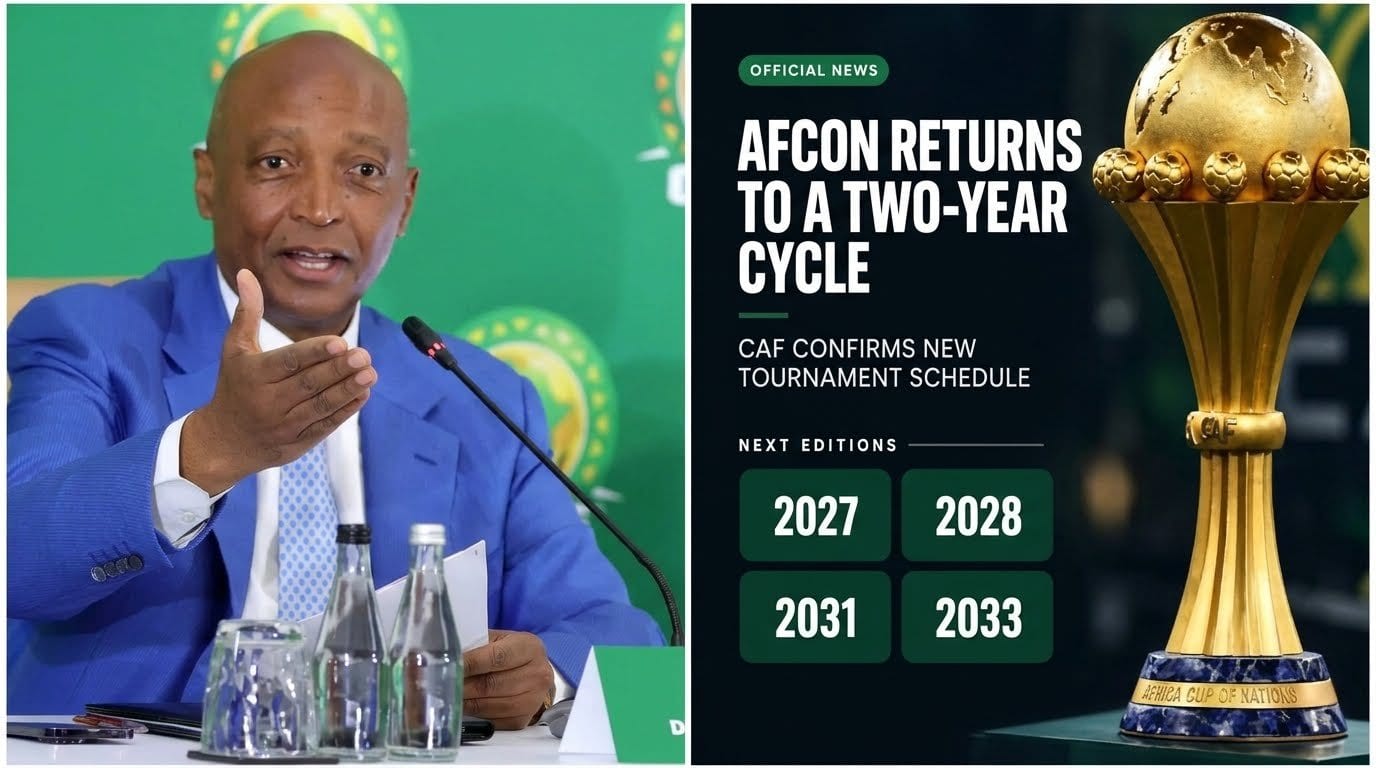
The Confederation of African Football (CAF) has officially made a dramatic U-turn, reversing its previous decision to hold the Africa Cup of Nations (AFCON) every four years and fully restoring the tournament's traditional two-year cycle. The decision was unanimously ratified by the CAF Executive Committee on Thursday, October 29, 2026, completely scrapping the quadrennial format that had been introduced just ten months earlier. This massive policy shift ensures that Africa’s premier international football showpiece retains its familiar, regular place on the global sporting calendar.
The original decision to shift the flagship competition to a four-year cycle was announced in December 2025, right before the commencement of the 2025 edition in Morocco. At the time, continental soccer governors aimed to align the African tournament with the international football calendar and ease scheduling tensions with prominent European clubs. However, following intense backlash from member nations, coaches, and local fans, the governing body chose to re-examine the change during strategic assemblies in Cape Verde.
CAF President Dr. Patrice Motsepe formally confirmed the policy reversal, emphasizing that the decision was necessary to protect the structural and developmental interests of the continent's 54 member nations. "The decision by the Executive Committee to reinstate the organisation of the AFCON every two years aims to advance, protect and promote the interests of African football," Motsepe explained in an official press release. He noted that the move is also designed to safeguard African players who continuously look forward to showcasing their talents on the big stage.
A primary catalyst for the unexpected U-turn was the apparent financial unviability of CAF's proposed alternative tournament, the Africa Nations League. Under the initial reform plans, this new pan-African Nations League was designed to serve as the biennial placeholder to keep national teams engaged between four-year gaps. However, financial models quickly revealed that the new tournament would require a minimum of several years just to generate enough independent revenue to become self-sufficient.
AFCON remains the absolute financial lifeblood of the continent’s football infrastructure, serving as the main source of income to bankroll grassroots and youth soccer. For context, the 2025 tournament in Morocco alone was projected to yield an impressive $114 million in profit, showing a sharp rise from the $75 million recorded in 2023. The unpredictable revenues of a brand-new, untested league system presented too much of a financial risk for a governing body trying to stay globally competitive.
The return to a two-year format provides immediate stability for national federations that heavily rely on the broadcast and sponsorship rights generated by the flagship event. The tournament's commercial popularity has soared exponentially, with its corporate sponsor portfolio expanding rapidly from nine brands in 2021 to a massive pool of 23 for the Moroccan edition. Keeping a reliable, two-year rhythmic cycle provides member associations with a predictable, steady stream of funding to manage their domestic leagues.
While African fans and local administrators have celebrated the return of their beloved biennial festival, the decision will undoubtedly reignite old club-versus-country disputes. Staging the tournament every two years has historically clashed with the European club calendar, forcing top stars to leave their clubs mid-season. Furthermore, with FIFA actively expanding its Club World Cup to a massive 32-team format during the summer months, finding open dates on the calendar remains an active logistical puzzle.
Alongside the historic scheduling announcement, CAF has laid out a clear roadmap for the next four editions of the tournament to prevent any further confusion. The next highly anticipated edition of the Africa Cup of Nations will take place in 2027, with East African neighbors Kenya, Tanzania, and Uganda serving as joint hosts. This landmark tournament will represent a major milestone for football development across the East African region.
Following the 2027 showpiece, subsequent iterations of the tournament have been officially locked in for 2028, 2031, and 2033. Interestingly, the governing body has intentionally left a vacant gap on the calendar for the year 2030. This intentional omission follows strict international soccer traditions, which dictate that continental finals are not held during a FIFA World Cup year to prevent media and physical player exhaustion.
The confirmation of the upcoming schedule brings a sense of finality to what has been a highly volatile and argumentative period for African football governance. Analysts had previously noted that pushing the event to a four-year cycle favored world governing bodies like FIFA rather than local interests. By prioritizing its primary tournament, CAF has firmly reasserted its administrative independence and protected its core financial asset.
As mobilization and stadium infrastructure developments gather pace across Kenya, Tanzania, and Uganda, the focus of the continent now shifts back to on-field action. With the two-year rhythm safely restored, African nations can continue building their squads with regular high-level competition. The decision cements the Africa Cup of Nations as not just a sporting event, but a cultural phenomenon that will continue to unite the continent every two years.
Comments
Join the conversation. Please keep it respectful.
No comments yet — be the first to share your thoughts.